
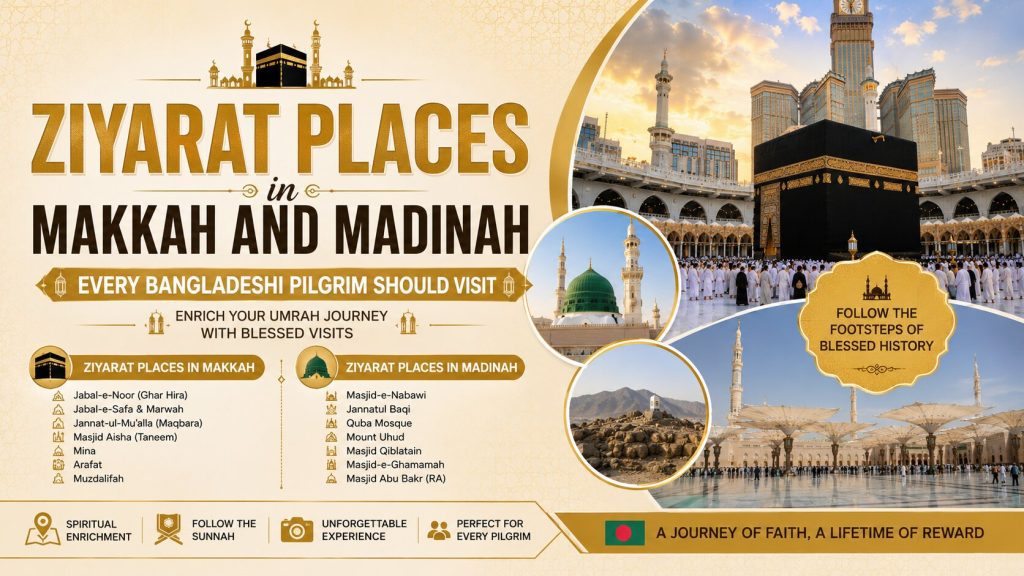
Umrah itself takes only a few hours: tawaf, sa’i, and the trimming of hair. What fills the rest of your days in Saudi Arabia is ziyarat — visiting the places where the history of Islam actually happened. Standing at the foot of Jabal al-Nour, where the first verses of the Quran were revealed, or praying in Masjid Quba, the first mosque ever built, turns a trip into a lifetime memory. Most Umrah packages from Bangladesh include one guided ziyarat day in Makkah and one in Madinah. This guide covers what you will see, what each place means, and the practical details Bangladeshi pilgrims ask about most.
Ziyarat Places in Makkah
Jabal al-Nour and the Cave of Hira
About 4 kilometres from the Haram stands the Mountain of Light, where the Prophet Muhammad (peace be upon him) received the first revelation in the Cave of Hira. The climb takes 45 minutes to 2 hours depending on your fitness, up roughly 1,200 uneven steps. Most guided tours stop at the base for photographs and explanation; climbing is optional and best attempted early morning before the heat. If you are travelling with older family members, view it from the base — the story matters more than the climb.
Jabal Thawr
South of Makkah is the Cave of Thawr, where the Prophet (peace be upon him) and Abu Bakr (may Allah be pleased with him) hid for three days during the migration to Madinah. This is the cave protected by the famous spider’s web. Like Hira, the climb is steep and optional; tour buses stop at the viewing point.
Arafat, Muzdalifah and Mina
Even outside Hajj season, visiting the plains of Arafat is moving — this is where millions stand together every year on the Day of Arafah, and where the Prophet (peace be upon him) delivered his Farewell Sermon at Jabal al-Rahmah (the Mount of Mercy). Your bus will typically drive through Mina’s endless white tent city and pass Muzdalifah on the same route. If you are curious what these sites are like during the pilgrimage itself, read our post on Hajj Accommodation in Mina, Arafat and Makkah.
Masjid Aisha (Masjid Taneem)
This mosque marks the nearest miqat boundary to Makkah. Pilgrims who want to perform a second Umrah enter ihram here rather than travelling back to a distant miqat. Taxis from the Haram take about 15 minutes, and many pilgrims combine a ziyarat stop with a fresh niyyah for another Umrah — a common practice on 10-day and 14-day packages where time allows.
Jannat al-Mualla
Makkah’s ancient cemetery, resting place of Khadijah (may Allah be pleased with her), the Prophet’s first wife, and several of his ancestors. Visitors may make dua from the boundary; entry into the cemetery itself is restricted for women.
Ziyarat Places in Madinah
Masjid Quba
The first mosque built in the history of Islam, founded by the Prophet (peace be upon him) himself upon arriving in Madinah. An authentic hadith promises that whoever purifies himself at home and prays two rakats in Masjid Quba earns the reward of an Umrah. It sits about 5 kilometres from Masjid an-Nabawi; many pilgrims follow the Sunnah of visiting on a Saturday.
Mount Uhud and the Martyrs’ Cemetery
The site of the Battle of Uhud, where 70 companions including Hamza (may Allah be pleased with him), the Prophet’s uncle, were martyred. Standing before the simple fenced cemetery with the mountain rising behind it is one of the most emotional moments of any ziyarat day. The Prophet (peace be upon him) said, “Uhud is a mountain that loves us and we love it.”
Masjid Qiblatain
The Mosque of the Two Qiblas, where the command came to change the direction of prayer from Jerusalem to Makkah mid-prayer, according to the famous narration. The mosque’s architecture still commemorates both directions.
The Trench (Khandaq) and the Seven Mosques
On the western edge of Madinah lie the small mosques marking where the Battle of the Trench was fought. Most tours make a brief stop here after Qiblatain.
Jannat al-Baqi
The main cemetery of Madinah, directly beside Masjid an-Nabawi, holds thousands of companions, wives, and family members of the Prophet (peace be upon him). Men may enter after Fajr in the morning; women make dua from outside the walls.
Rawdah: Book Before You Go
Inside Masjid an-Nabawi, the area between the Prophet’s house and his pulpit is described in hadith as a garden from the gardens of Paradise. Entry now requires a free appointment through the Nusuk app, and slots fill quickly. Ask your agency to help you book Rawdah appointments as soon as your travel dates are confirmed — this is one of the details a good agency handles for you, and one reason choosing a trusted agency matters more than a small price difference.
Practical Tips for Ziyarat Days
- Timing: Guided ziyarat usually runs 7 AM to 12 PM, between Fajr and Zuhr, to avoid the afternoon heat.
- Dress: Normal modest clothing — you are not in ihram during ziyarat days.
- Language: Bangladeshi group tours run with Bangla-speaking guides; private tours can be arranged in Bangla on request. Guides who explain the history in your own language make an enormous difference.
- Money: Carry small riyal notes for water, dates, and souvenirs at stops.
- Photography: Allowed at almost all outdoor sites; be respectful at cemeteries where photography of graves is discouraged.
- Etiquette: Learn the duas for visiting graves and mosques before you travel. Our Umrah training program covers ziyarat etiquette alongside the rituals themselves.
Is Ziyarat Included in Your Package?
Standard packages include shared bus ziyarat in both cities. VIP packages typically upgrade this to private cars with flexible timing — worth it for families with elderly members or anyone who wants to spend longer at each site. Compare what is included in our VIP luxury Umrah package against economy options, or see the full range of Umrah Packages from Bangladesh.
Frequently Asked Questions
Is ziyarat a required part of Umrah?
No. Umrah consists of ihram, tawaf, sa’i, and cutting the hair — nothing else is obligatory. Ziyarat is a voluntary act of visiting historically and spiritually significant places, and almost every pilgrim chooses to do it. Learn the required rituals in our guide on How to Perform Umrah.
How many days do I need for proper ziyarat in both cities?
One dedicated day in each city covers the main sites. Packages of 10 days or longer give you time for repeat visits to favourites like Masjid Quba and unhurried time in the Haramain.
Can women visit all ziyarat places?
Women visit all the mosques and outdoor sites. Entry inside the cemeteries (Jannat al-Baqi and Jannat al-Mualla) is restricted for women, who make dua from the boundary instead. Rawdah has dedicated women’s appointment slots read more in Our guide for women performing Umrah from Bangladesh.
Is climbing Jabal al-Nour safe for older pilgrims?
The climb is strenuous and not recommended for elderly pilgrims or anyone with heart or knee conditions. The base viewing area offers the history without the risk. Every UmrahLovers package includes guided ziyarat with Bangla-speaking support in both Makkah and Madinah. See Our Packages or Contact Us to plan your journey.